VENI, VINDy, VICI: a generative reduced-order modeling framework with uncertainty quantification
Abstract
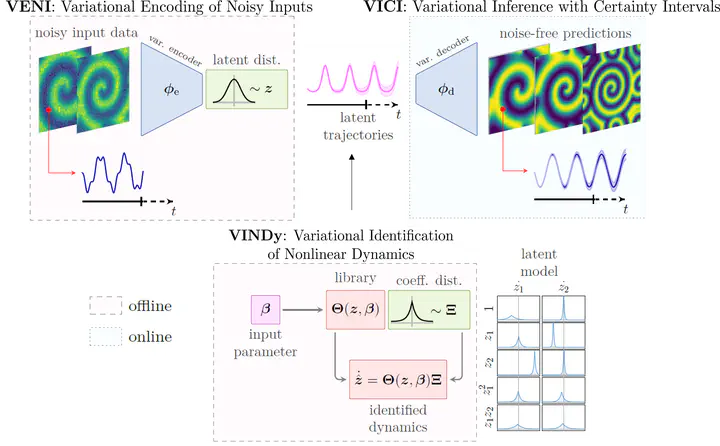
Generative models are transforming science and engineering by enabling efficient synthetization and exploration of new scenarios for complex physical phenomena with minimal cost. Although they provide uncertainty-aware predictions to support decision making, they typically lack physical consistency, which is the backbone of computational science. Hence, we propose VENI, VINDy, VICI – a novel physical generative framework that integrates data-driven system identification into a probabilistic modeling approach to construct physically consistent and efficient reduced-order models with uncertainty quantification. First, VENI (Variational Encoding of Noisy Inputs) employs variational autoencoders to identify reduced coordinates from high-dimensional, noisy measurements. Simultaneously, VINDy (Variational Identification of Nonlinear Dynamics) extends sparse system identification methods by embedding probabilistic modeling into the discovery process. Last, VICI (Variational Inference with Credibility Intervals) enables efficient generation of full-time solutions and provides uncertainty quantification for unseen parameters and initial conditions. We demonstrate the performance of the framework across chaotic and high-dimensional nonlinear systems.

Paolo Conti
Principal Research Scientist
My research interests include scientific machine learning, multi-fidelity and reduced-order modeling.